Table of Contents
Key takeaways:
- Electric cargo tricycles are becoming increasingly relevant for short-distance delivery, local distribution, facility transport, and urban logistics.
- A three-wheel cargo platform can provide greater low-speed loading stability than many conventional two-wheel delivery scooters.
- Motor power, battery capacity, cargo-box dimensions, payload, braking, tires, and road gradient should be evaluated together.
- Last-mile delivery is not only about maximum range; stop frequency, loading time, parking access, route density, and vehicle downtime can strongly affect operational efficiency.
- Compact electric delivery vehicles can be particularly useful in narrow streets, residential districts, campuses, factories, markets, and local delivery networks.
- Buyers should test a vehicle under realistic cargo loads instead of relying only on unloaded factory demonstrations.
- OEM configurations should reflect local road regulations, commercial applications, climate, charging infrastructure, and maintenance capability.
- Spare parts and after-sales planning are essential for commercial fleets because downtime can directly affect daily delivery operations.
Introduction
Urban delivery is changing quickly. Growing e-commerce activity, pressure to reduce urban transport emissions, tighter delivery windows, and increasing interest in smaller electric vehicles are encouraging logistics operators to reconsider how goods move through the final stage of distribution.
The concept of last-mile delivery describes the final stage of moving goods from a transportation or distribution hub to the final destination. This stage can involve dense delivery routes, repeated stops, limited parking access, and smaller individual shipments, making vehicle selection particularly important.
Electric two- and three-wheelers are already one of the most electrified road-transport segments globally. According to the International Energy Agency’s Global EV Outlook 2026, global sales of electric two- and three-wheelers increased by almost 15% in 2025 to approximately 11 million units.
At the same time, organizations such as the United Nations Environment Programme are promoting smaller electric vehicles for urban transportation and delivery. UNEP’s Deliver-E Coalition specifically focuses on accelerating cleaner electric delivery solutions, reflecting the increasing importance of lightweight electric vehicles in last-mile logistics.
Within this environment, the Electric Cargo Tricycle provides an interesting middle ground between a conventional delivery scooter and a larger commercial vehicle.
It is compact enough for short-distance urban operation while providing a dedicated rear cargo area, three-wheel stability, and a larger carrying platform than many ordinary two-wheel electric scooters.
For a newly established electric mobility brand or distributor, this category also creates opportunities in delivery fleets, industrial transportation, local retail distribution, food and beverage delivery, market logistics, maintenance services, and private-site transport.
What Is an Electric Cargo Tricycle?
An Electric Cargo Tricycle is a three-wheeled electric vehicle designed primarily for transporting goods rather than passengers.
The broader concept of a cargo tricycle has a long history in commercial goods transportation. Modern versions increasingly combine traditional three-wheel cargo layouts with electric propulsion, batteries, controllers, and purpose-built loading structures.
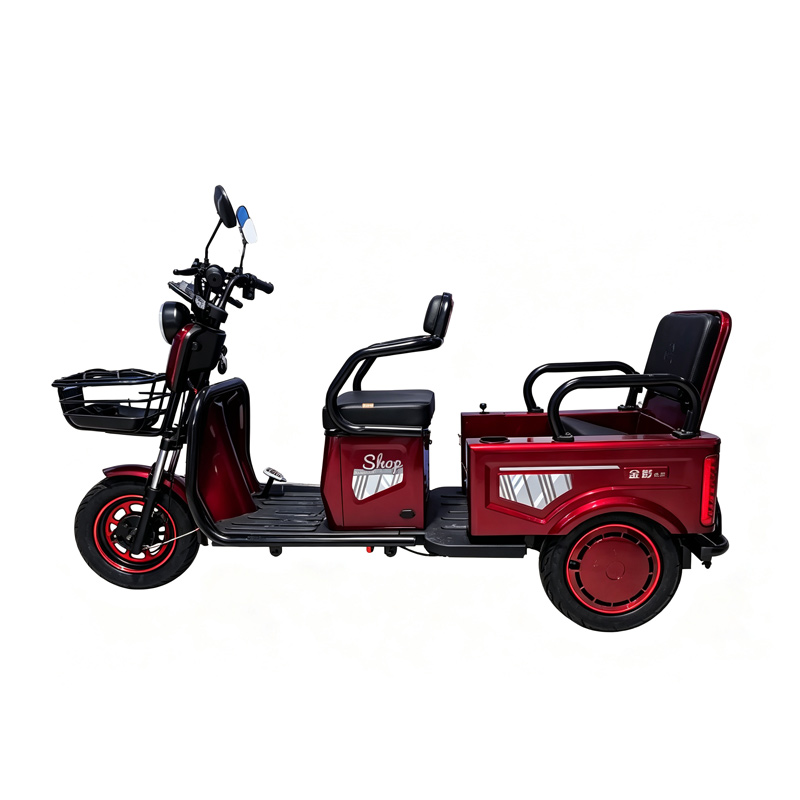
Most electric cargo models combine one front steering wheel with two rear wheels supporting a cargo box, flatbed, basket, or customized loading structure.
The electrical system normally includes:
- Battery
- Electric motor
- Controller
- Charger
- Dashboard
- Wiring system
- Lighting
- Throttle and control switches
The mechanical structure usually includes:
- Main frame
- Rear cargo platform
- Front fork
- Suspension
- Brakes
- Wheels and tires
- Steering system
How It Differs From a Passenger Tricycle
Passenger tricycles prioritize seating, passenger access, comfort, weather protection, and interior space.
A cargo model instead concentrates its structure around loading space, frame strength, weight distribution, rear axle support, and practical access for loading and unloading.
Hongtu Future’s current Electric Cargo Tricycle – Little Fighter reflects this type of design. Its configuration includes a foldable rear cargo box, 650W sine-wave motor, 48–60V 20Ah battery platform, hydraulic front suspension, and 300-10 tubeless tires.
Electric Cargo Tricycle vs Delivery Scooter
A delivery scooter is normally narrower and lighter, making it suitable for quick individual deliveries.
A cargo tricycle provides a larger and more stable loading platform at low speed, which can be useful when goods are bulky, heavier, or difficult to secure on a two-wheel vehicle.
Hongtu Future also offers an Electric Cargo Scooter category, allowing distributors to build different delivery solutions around separate payload, route, and maneuverability requirements.
Why Electric Cargo Tricycles Fit 2026 Last-Mile Delivery Trends
Last-mile logistics increasingly requires vehicles that can move efficiently through dense urban environments without using a full-size van for every shipment.
Smaller electric vehicles can be especially useful when routes involve frequent stops, short distances, limited parking space, narrow roads, or repeated trips from a local distribution point.
This broader movement toward small vehicles for short-distance urban transportation is often associated with micromobility, although the exact regulatory definition and vehicle categories vary between markets.
More Right-Sized Delivery Vehicles
A large delivery van can carry significant volume, but that capacity may be unnecessary for every route.
An Electric Cargo Tricycle can serve smaller delivery rounds where compact dimensions and maneuverability matter more than maximum cargo volume.
This makes it potentially useful for:
- Local parcel distribution
- Grocery delivery
- Restaurant supply
- Fresh-food transport
- Hardware delivery
- Market transport
- Campus deliveries
- Factory material movement
- Maintenance services
- Local commercial distribution
Growth of Electric Two- and Three-Wheel Mobility
The continued electrification of two- and three-wheel transport provides a strong macro trend for this category.
The IEA reports that electric two- and three-wheelers remained the most electrified road transport segment in 2025, with about 10% of the global fleet already electric.
The UNEP Electric Two- and Three-Wheelers programme also highlights the importance of this vehicle class in low- and middle-income countries, where two- and three-wheel transport already plays an important role in everyday mobility.
For SEO purposes, this creates opportunities to build content around both vehicle keywords and application-oriented searches, including:
- electric delivery vehicle
- electric cargo tricycle
- last-mile delivery vehicle
- electric three-wheeler
- cargo electric vehicle
- urban delivery vehicle
- electric cargo scooter
Last-Mile Delivery Is Becoming More Specialized
Modern urban logistics increasingly uses different vehicle sizes for different delivery environments rather than depending on one vehicle type for every route.
A compact vehicle can be deployed from a warehouse, local distribution center, retail location, market, or neighborhood depot and used for repeated short-distance trips.
This is one reason application-focused content can be valuable for SEO. Commercial searchers frequently begin with a problem such as “which electric vehicle is suitable for last-mile delivery?” rather than searching only for a generic product name.
Electric Cargo Tricycle vs Electric Cargo Scooter
Both products can serve commercial transportation, but their operating characteristics are different.
| Comparison | Electric Cargo Tricycle | Electric Cargo Scooter |
|---|---|---|
| Wheel configuration | Three wheels | Two wheels |
| Low-speed cargo stability | Higher | Requires rider balance |
| Cargo area | Usually larger | Usually smaller |
| Vehicle width | Wider | Narrower |
| Maneuverability | Good in compact areas | Very high |
| Bulky loads | Generally more suitable | Better for lighter loads |
| Parking footprint | Moderate | Small |
| Rider learning curve | Stable at low speed | Requires two-wheel riding skills |
| Delivery density | Good for multi-item routes | Good for rapid small deliveries |
| Typical use | Goods transport and local distribution | Food, parcels and express delivery |
When a Cargo Tricycle Makes More Sense
A three-wheel vehicle can be preferable when cargo volume and loading stability are more important than narrow vehicle width.
Businesses carrying cartons, tools, packaged food, supplies, or several customer orders on a single route may benefit from a dedicated rear cargo platform.
When a Delivery Scooter Makes More Sense
A two-wheel delivery scooter may be more suitable when routes are highly congested and individual orders are relatively small.
It can also be easier to park and maneuver in environments where available space is extremely limited.
Rather than treating these products as direct replacements for one another, distributors can position them for different delivery tasks.
Key Electric Cargo Tricycle Specifications to Compare
Commercial vehicle selection should begin with the work the vehicle needs to perform.
A specification is useful only when it can be connected to a real route, load, and operating environment.
Motor Power
Motor power affects acceleration, climbing, loaded performance, and the vehicle’s ability to maintain speed.
However, a higher wattage figure does not automatically mean better commercial performance.
Buyers should consider:
- Gross vehicle weight
- Cargo weight
- Maximum gradient
- Wheel diameter
- Controller current
- Battery voltage
- Required speed
- Continuous operating time
The Little Fighter currently uses a 650W sine-wave spline-shaft motor together with a large 12-tube sine-wave controller.
Motor and Controller Matching
The controller determines how electrical current is supplied from the battery to the motor.
A properly matched motor-controller combination can contribute to smoother starts, predictable acceleration, and controlled loaded operation.
For commercial fleets, replacement controllers should also be available because a failed electrical component can remove an otherwise functional vehicle from service.
Battery System
Battery selection influences range, charging time, vehicle weight, performance under load, and lifecycle planning.
When comparing batteries, voltage and amp-hour capacity should be reviewed together.
A simple nominal-energy calculation is:
Battery energy = voltage × amp-hour capacity
Modern electric vehicles commonly use rechargeable battery technologies such as the lithium-ion battery, which offers relatively high energy density compared with many older rechargeable battery technologies.
However, nominal energy is not the same as actual usable energy.
Real performance depends on:
- Battery chemistry
- Temperature
- Depth of discharge
- Battery age
- Cell quality
- Controller demand
- Vehicle load
- Charging conditions
Cargo Box Size
Cargo-box dimensions are often more useful than general descriptions such as “large capacity.”
The Little Fighter Electric Cargo Tricycle uses a foldable rear cargo structure designed to improve loading flexibility.
Buyers should compare actual cargo dimensions with the cartons, containers, tools, food boxes, or delivery packages used in their business.
Frame Structure
Cargo weight acts directly on the frame and rear section of the vehicle.
Frame evaluation should include:
- Welding quality
- Rear axle mounting
- Cargo-box supports
- Surface treatment
- Corrosion protection
- Battery mounting
- Suspension attachment points
A visually large cargo box does not necessarily mean the frame is suitable for heavier loads.
Tires and Suspension
Commercial delivery places repeated stress on tires and suspension.
Buyers should check tire dimensions, load ratings, tread, local replacement availability, recommended pressure, and suspension performance under real cargo weight.
The Little Fighter uses 300-10 tubeless tires and a hydraulic front suspension configuration designed for changing urban and commercial road conditions.
Choosing a Cargo Tricycle by Delivery Scenario
There is no universal configuration for every delivery business.
The most useful starting point is the cargo itself.
Parcel and E-Commerce Delivery
Parcel routes often involve many stops and relatively lightweight packages.
Important factors include:
- Easy loading
- Cargo organization
- Turning radius
- Battery reserve
- Reliable brakes
- Driver visibility
- Quick parking
A box or lockable enclosure may also be useful where parcels must remain protected between stops.
Grocery and Fresh-Food Distribution
Food delivery may require washable surfaces, weather protection, insulated containers, or separate compartments.
Payload should include not only the products but also boxes, insulated equipment, ice packs, racks, and other supporting materials.
Local Retail Distribution
Small retailers may use cargo tricycles to move products between warehouses, stores, markets, and nearby customers.
These operations frequently prioritize practical cargo volume, simple charging, low-speed stability, and easy maintenance.
Factory and Industrial Transport
Factories may use compact electric cargo vehicles for moving tools, spare parts, packaging materials, components, or maintenance equipment.
Routes are often predictable, making battery and charging planning easier.
Campus and Private-Site Logistics
Hotels, universities, resorts, exhibition centers, residential communities, and industrial parks can use cargo tricycles for internal transportation.
Because these routes are controlled, operators can establish fixed charging locations and standard maintenance schedules.
Hongtu Future’s Electric Mobility Applications can connect this cargo-focused article with wider delivery, industrial transportation, commuting, and commercial electric mobility topics.
Electric Mobility and Emerging Markets
Electric two- and three-wheelers are especially relevant in markets where compact vehicles already play a major role in transportation and commercial activity.
The World Bank’s research on Electric Mobility in Developing Countries discusses the role of electric two- and three-wheelers alongside other electric transport modes and notes the development of battery-swapping and electrification models in Asian and African markets.
For manufacturers and distributors, this means product configurations should not be copied blindly between countries.
Road conditions, electricity supply, battery infrastructure, climate, local vehicle classifications, cargo requirements, and commercial operating patterns can differ significantly.
What Determines Real Delivery Range?
Maximum advertised range should not be the only decision factor.
A commercial cargo tricycle may operate very differently from the same vehicle during an unloaded test.
Cargo Weight
Additional load increases energy demand during acceleration and climbing.
Routes with frequent stops can amplify this effect because the motor repeatedly moves the vehicle from rest.
Road Gradient
Hill climbing increases motor and battery demand.
For hilly markets, a loaded climbing test should be included during sample evaluation.
Stop Frequency
A route with many short stops may consume energy differently from one continuous trip covering the same distance.
Stop frequency should therefore be included when estimating daily battery requirements.
Temperature
Battery performance can change under very hot or cold conditions.
The correct range margin should reflect the destination climate rather than relying only on ideal testing conditions.
Tire Pressure
Underinflated tires increase rolling resistance.
Commercial operators should include tire-pressure checks in routine inspections because small maintenance issues can reduce efficiency across an entire fleet.
Why a Range Reserve Matters
A delivery vehicle should not regularly finish its route with almost no remaining energy.
A practical reserve provides protection against:
- Detours
- Additional deliveries
- Traffic
- Heavier loads
- Battery aging
- Cold weather
- Charging interruptions
How to Evaluate Total Fleet Efficiency
The best Electric Cargo Tricycle is not necessarily the model with the largest battery.
Fleet efficiency should include the entire operating process.
Loading Time
A well-designed cargo area can reduce the time needed to load and unload goods.
When the vehicle completes dozens of stops each day, small operational improvements can accumulate.
Parking Access
Compact electric delivery vehicles may be easier to position near delivery destinations than larger commercial vehicles, depending on local traffic and parking regulations.
This can reduce unnecessary walking distance between the vehicle and delivery point.
Vehicle Availability
Commercial vehicles create value only when they are operating.
Fleet managers should therefore track:
- Charging downtime
- Maintenance downtime
- Battery replacement
- Tire replacement
- Brake service
- Electrical faults
Cost Per Delivery
Instead of evaluating only vehicle acquisition cost, commercial operators can calculate:
Total operating cost ÷ number of completed deliveries
The calculation can include electricity, maintenance, batteries, tires, labor, insurance, downtime, and other operating expenses.
OEM Electric Cargo Tricycle Considerations
For overseas distributors and private-label brands, the standard factory configuration may need adjustments.
Hongtu Future provides OEM and ODM customization across its electric mobility range.
Cargo Structure Customization
Possible cargo configurations can include:
- Open cargo box
- Enclosed box
- Lockable compartment
- Flatbed
- Tool box
- Food-delivery box
- Insulated container
- Branded commercial enclosure
The structure should be developed according to load distribution and frame capacity.
Branding
Commercial vehicles provide visible advertising space.
OEM buyers may customize:
- Logo
- Body color
- Cargo-box graphics
- Fleet numbers
- Warning labels
- Packaging
- User manuals
Electrical Configuration
Motor power, controller settings, battery voltage, charger input, lights, and speed settings may need adjustment according to local regulations and applications.
Any electrical change should be tested as a complete vehicle system.
How to Evaluate an Electric Cargo Tricycle Manufacturer
A reliable supplier should provide more than a basic product specification.
Commercial buyers should evaluate production consistency, sample approval, testing, documentation, spare-parts availability, and customization support.
Ask for Clear Technical Data
Important information includes:
- Rated motor power
- Controller specification
- Battery voltage and capacity
- Cargo dimensions
- Rated payload
- Brake type
- Tire specification
- Charging time
- Test-condition range
- Vehicle dimensions
- Vehicle weight
Test the Vehicle Under Load
A useful sample test should reproduce actual working conditions.
The vehicle should be evaluated with representative cargo on normal road surfaces and, where relevant, slopes.
Plan Spare Parts Before Shipment
Important spare components may include:
- Controllers
- Chargers
- Brake components
- Tires
- Switches
- Lights
- Throttles
- Bearings
- Electrical connectors
- Displays
For commercial fleet applications, parts availability can be just as important as the initial vehicle specification.
Conclusion
Electric cargo tricycles are becoming increasingly relevant to businesses looking for compact vehicles for local distribution, last-mile logistics, industrial transport, and repeated short-distance delivery.
The strongest advantage of an Electric Cargo Tricycle is not simply that it has three wheels or an electric motor.
Its value comes from matching cargo capacity, vehicle dimensions, motor performance, battery capacity, road conditions, route density, charging access, maintenance support, and local regulations.
For commercial procurement, buyers should begin with real delivery data: what will be carried, how far the vehicle travels, how many times it stops, where it charges, what roads it uses, and how quickly spare parts can be obtained.
The continued development of electric two- and three-wheelers, combined with growing interest in cleaner last-mile transportation, creates a strong environment for more specialized electric delivery vehicles.
For businesses evaluating compact cargo mobility, Hongtu Future’s Electric Cargo Tricycle – Little Fighter provides a current example built around a foldable cargo structure, compact chassis, electric drive system, hydraulic front suspension, and tubeless tires.
FAQ
Is an Electric Cargo Tricycle good for last-mile delivery?
Yes, it can be suitable for short and medium local delivery routes where compact size, cargo stability, and frequent stopping are important. The correct model depends on cargo weight, route distance, gradient, road conditions, and local vehicle regulations.
How do I choose the right motor for an Electric Cargo Tricycle?
Start with the expected total load, road gradient, required speed, and daily operating pattern. Motor wattage should be considered together with controller current, battery voltage, wheel size, and vehicle weight rather than evaluated as a single specification.
How much cargo can an electric delivery tricycle carry?
Payload varies significantly between vehicle designs. Buyers should request the manufacturer’s rated payload and test the vehicle with realistic goods. Frame strength, rear axle, brakes, tires, and weight distribution are just as important as cargo-box dimensions.
Is an Electric Cargo Tricycle better than a delivery scooter?
It depends on the application. A cargo tricycle generally offers more loading stability and cargo space, while a two-wheel delivery scooter is narrower and more agile. Many fleets can use the two vehicle types for different delivery routes.
What should importers check before ordering electric cargo tricycles?
Check motor and battery specifications, rated payload, cargo dimensions, brakes, tires, suspension, charger compatibility, spare parts, certification requirements, and sample performance. A loaded road test should be completed before approving mass production.