Table des matières
Principaux points à retenir
- A Torque Sensor E-Bike responds to how much force the rider applies to the pedals, while a cadence-sensor system primarily detects whether and how quickly the crank is rotating.
- Torque sensing usually creates a more proportional and natural pedal-assist experience, especially during starts, climbing, changing terrain, and low-speed riding.
- Cadence sensors remain practical for riders who prefer straightforward electric assistance and for products where simplicity and cost control are important.
- Sensor type affects riding feel, but motor power, controller programming, battery capacity, gearing, bike weight, and tire size are equally important.
- Torque sensing does not automatically increase range in every situation, although smoother power delivery can help riders use assistance more selectively.
- Heavy fat-tire and moped-style e-bikes can benefit from predictable low-speed assistance because their greater vehicle weight changes acceleration and handling.
- Importers should test sensor response under realistic riding conditions rather than comparing products only by motor wattage and battery capacity.
- OEM buyers should define sensor behavior, assistance levels, controller tuning, motor configuration, and target-market regulations before approving mass production.
- In 2026, smarter pedal-assist systems are becoming increasingly relevant as electric bicycles move beyond basic motor-and-battery specifications toward a more refined overall riding experience.
Introduction
Electric bicycle specifications used to be dominated by a few easily understood numbers: motor wattage, battery capacity, maximum speed, and advertised range.
Those numbers still matter, but they no longer explain the complete riding experience.
As the electric bicycle market becomes more mature, buyers are paying greater attention to how the motor actually responds to the rider. A 750W e-bike can feel very different from another 750W model even when the battery, tire size, and nominal power appear similar.
One of the main reasons is the pedal-assist sensor.
The two most common approaches are torque sensing and cadence sensing.
A Torque Sensor E-Bike measures the rider’s pedaling force and adjusts motor assistance according to that input. A cadence-sensor e-bike primarily detects crank rotation and activates assistance according to the selected control logic.
Both systems can work well.
However, they produce noticeably different riding behavior and are better suited to different product positions.
This distinction is becoming more important as the global electric two- and three-wheel market continues to expand. The Perspectives mondiales des véhicules électriques 2026 de l'Agence internationale de l'énergie reports especially strong momentum for electric two- and three-wheelers in several emerging markets entering 2026.
For manufacturers, distributors, and private-label brands, understanding sensor technology can therefore help create more clearly differentiated products instead of competing only through larger motors or batteries.
Qu'est-ce qu'un vélo électrique à capteur de couple ?
A Torque Sensor E-Bike uses a sensor system to detect the force the rider applies while pedaling.
When the rider pushes harder on the pedals, such as during acceleration or climbing, the system can request more motor assistance. When pedal pressure decreases, assistance can also decrease.
This creates a closer relationship between human effort and electric support.
The broader concept is closely related to the pedelec, where motor assistance is controlled through sensors that can detect pedaling speed, crank torque, or a combination of both.
Comment le couple est détecté
Torque represents a rotational force.
In bicycle applications, torque-sensing systems may measure deformation or force around the crank, bottom bracket, axle, rear dropout, or another part of the drivetrain.
Many force-measuring systems use strain-based sensing principles. Similar technology is also used in cycling power meters, where strain gauges can measure applied torque and combine that information with rotational speed to estimate rider power. The basic measurement concept is explained in the cycling power meter overview.
The exact sensor location and design depend on the motor system and bicycle architecture.
Que se passe-t-il lorsque le cavalier pédale ?
When the rider begins applying pressure, the sensor sends information to the controller.
The controller then determines how much electrical assistance should be delivered according to factors such as:
- Force de pédalage
- Selected assistance level
- Motor programming
- Vehicle speed
- Controller settings
- System limits
The result is usually a progressive increase or decrease in assistance rather than a simple on/off response.
Un exemple simple
Imagine two situations.
On a flat road, the rider pedals gently. The system recognizes the relatively low force and provides moderate assistance.
When the same rider reaches a hill and pushes harder on the pedals, the sensor recognizes the increase in force and allows the control system to provide stronger assistance.
The rider therefore remains part of the control process.
Qu'est-ce qu'un E-Bike à Capteur de Cadence
A cadence sensor measures crank rotation rather than directly measuring how hard the rider is pushing.
In cycling, cadence refers to the rotational speed of the crank, normally expressed in revolutions per minute.
On a cadence-sensor e-bike, the control system detects that the pedals are turning and activates motor assistance according to the selected assistance mode and controller programming.
Comment fonctionnent les capteurs de cadence
Many cadence systems use magnets or another rotational detection method around the crank.
When the rider starts rotating the pedals, the system recognizes movement and sends a signal to the controller.
Motor assistance then activates according to predefined settings.
Ce que les capteurs de cadence ne mesurent pas
A cadence system does not necessarily know whether the rider is applying a large amount of force or simply rotating the pedals lightly.
This is the main difference between the two systems.
A rider may pedal gently while the controller continues supplying the programmed assistance level.
Pourquoi les capteurs de cadence restent populaires
Cadence sensors can still provide practical benefits.
They are generally straightforward, familiar, and suitable for products where riders want strong electric assistance without needing to contribute substantial physical effort.
They can also support simpler product architectures and cost-sensitive models.
Comparaison capteur de couple/capteur de cadence
The best sensor depends on the intended riding experience.
| Comparison Factor | Capteur de couple | Capteur de cadence |
|---|---|---|
| Main input measured | Force de pédalage | Crank rotation |
| Assistance response | Proportional to rider effort | Based mainly on pedal movement and settings |
| Initial riding feel | Usually progressive | Can feel more noticeable |
| Low-speed control | Often more precise | Depends strongly on controller tuning |
| Hill response | Reacts to increased pedal force | Relies more on selected assist level |
| Rider involvement | Supérieur | Can be lower |
| Natural bicycle feel | Generally stronger | Generally more motor-led |
| System complexity | Supérieur | Lower |
| Product cost | Often higher | Often lower |
| Best positioning | Refined, performance or premium riding | Practical, value-oriented electric assistance |
Aucun des deux systèmes ne fonctionne seul
The table should not be interpreted as meaning that every torque sensor is better than every cadence sensor.
A poorly calibrated torque sensor can produce an inconsistent ride.
A well-programmed cadence system can provide smooth and predictable assistance.
Motor behavior depends on the complete system, including the sensor, controller, motor, software, gearing, battery, wheel size, and vehicle weight.
Pourquoi les vélos électriques à capteur de couple semblent plus naturels
The main reason is proportional response.
Human riders naturally change pedal force throughout a journey.
They push harder when:
- Starting
- Climbing
- Accelerating
- Riding into wind
- Carrying additional load
They pedal more gently when:
- Cruising
- Descending
- Approaching a stop
- Riding through crowded areas
- Maintaining a steady speed
A torque-sensing system can respond to these changes.
Le Cavalier reste maître
Instead of asking only, “Are the pedals moving?” the control system effectively asks, “How much effort is the rider applying?”
This creates a closer relationship between rider intention and motor output.
À partir de basse vitesse
Heavy electric bicycles can require significant effort when beginning from rest.
A torque sensor can detect the increased pedal force during the first crank movement and request stronger assistance.
As the bicycle reaches cruising speed and rider effort decreases, assistance can become more moderate.
Coin et espaces restreints
Strong, sudden electric assistance is not always desirable.
In parking areas, crowded streets, narrow paths, or tight corners, riders may prefer a system that responds progressively to actual pedal input.
Naturel ne signifie pas faible
A torque-sensing system can still be paired with a powerful motor.
The difference is how that power is delivered.
A high-output motor combined with a well-tuned sensor can provide strong assistance when needed while remaining controllable during lighter pedaling.
Pourquoi les capteurs de couple conviennent aux vélos électriques de style cyclomoteur
Moped-style electric bicycles are generally heavier and more substantial than lightweight city bicycles.
They may combine:
- Larger motors
- Pneus larges
- Extended seats
- Stronger frames
- Hydraulic brakes
- Larger batteries
- Motorcycle-inspired components
These characteristics can increase vehicle mass and change low-speed behavior.
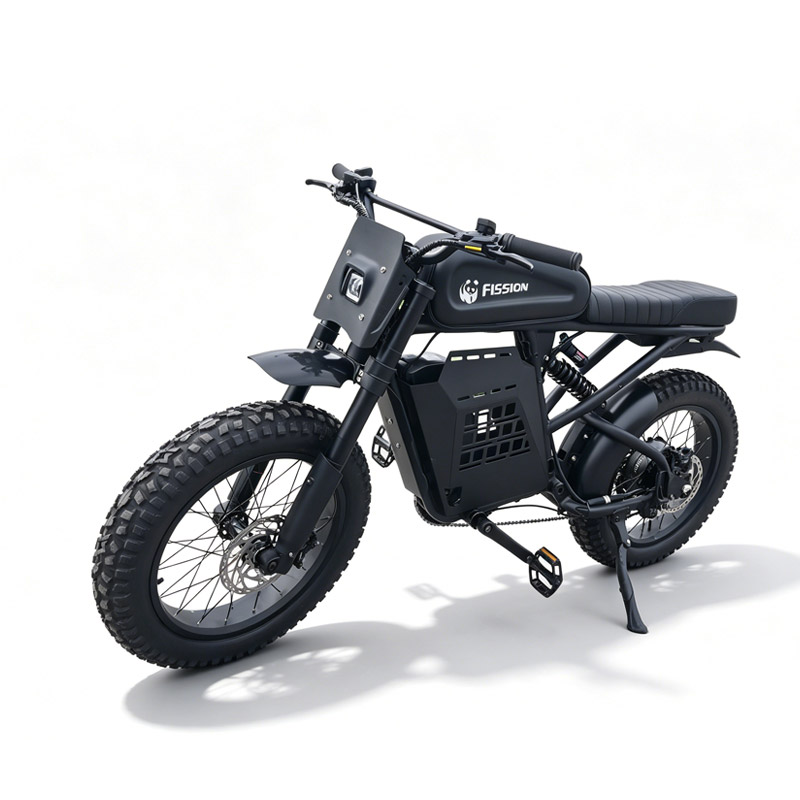
Hongtu Future Commuter-Focused Moped Style E-Bike S7 combines a 1500W motor, 48V 18Ah battery, torque-sensing drive system, front and rear hydraulic disc brakes, and 20 × 4.5 wide tires.
Contrôle d'une plateforme de puissance supérieure
A stronger motor can provide useful acceleration, but the way its output arrives is important.
Torque sensing allows assistance to respond to rider effort instead of depending only on crank rotation.
For a larger moped-style product, this can support a more predictable relationship between pedal pressure and acceleration.
Les pneus larges ajoutent de la résistance et du poids
The S7’s 20 × 4.5 tires provide a broad tire profile that supports its moped-inspired design.
However, wide tires also change rolling characteristics compared with narrow commuter tires.
When additional effort is needed to start or climb, a torque-sensitive assistance system can respond directly to increased rider input.
Les déplacements domicile-travail nécessitent une assistance variable
Urban commuting rarely involves one constant operating condition.
A rider may move between:
- Traffic lights
- Intersections
- Flat roads
- Small gradients
- Parking areas
- Shared paths
- Open roads
A responsive sensor can help the motor adapt more naturally to these changes.
Buyers evaluating the broader category can also review Hongtu Future’s existing article on Moped Style E-Bike Trends 2026, which explains how sensors, tires, batteries, braking, and regulatory considerations fit within current moped-inspired products.
Capteur de couple E-Bike vs Capteur de cadence pour les déplacements domicile-travail
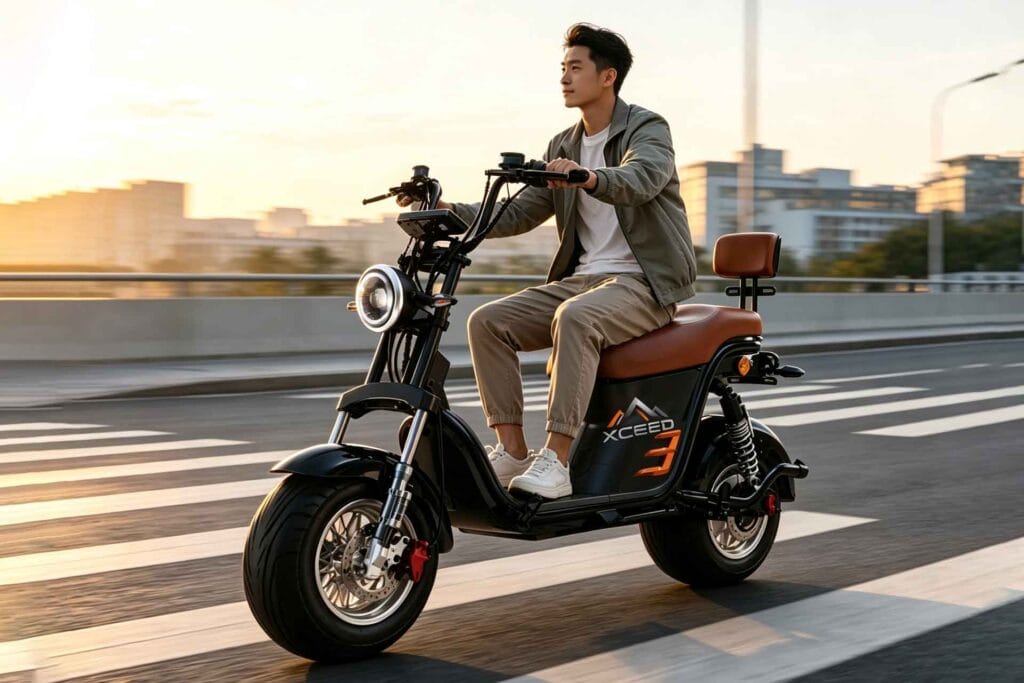
Daily commuting is one of the clearest applications where sensor choice becomes noticeable.
Trafic Stop-and-Go
Urban routes involve repeated acceleration.
A rider may stop at:
- Traffic lights
- Crosswalks
- Intersections
- Building entrances
- Parking areas
A Torque Sensor E-Bike can increase assistance when the rider pushes firmly from a stop and then reduce assistance as less pedal force is needed.
Longues routes stables
On long, flat routes, the difference may become less dramatic.
A cadence system can provide consistent assistance once the rider maintains pedal rotation.
For riders who prefer the motor to perform more of the work, this behavior may actually be desirable.
Zones urbaines surpeuplées
Low-speed modulation becomes important around pedestrians and other bicycles.
Progressive assistance can give riders more control over how quickly power increases.
La préférence du cavalier compte
Some riders want a bicycle-like experience with additional electric support.
Others want the easiest possible transportation with minimal physical effort.
Neither preference is wrong.
The sensor should match the customer.
Capteur de couple E-Bike vs Capteur de cadence pour Hills
Hills demonstrate the difference particularly clearly.
Capteur de couple en montée
When the rider begins pushing harder against the pedals, the system detects increased force.
The controller can respond with greater motor assistance according to its programming.
This creates a direct relationship between climbing effort and electrical support.
Capteur de cadence en montée
A cadence system recognizes that pedaling is taking place.
To receive more assistance, the rider may need to select a higher support level or rely on the controller’s programmed output.
The system does not necessarily recognize that pedal force has increased.
Le roulement compte toujours
Sensor choice cannot replace correct gearing.
A rider should still select a suitable gear before or during a climb.
The motor, gearing, sensor, controller, tire size, total weight, and battery voltage all influence hill performance.
Ne comparez pas les performances de Hill par capteur seul
A 250W torque-sensor bike and a 750W cadence-sensor bike are not directly comparable simply because their sensing technologies differ.
Motor output and complete vehicle configuration remain important.
Un capteur de couple améliore-t-il la portée du vélo électrique ?
This question appears frequently in buying research.
The correct answer is: it can influence energy use, but a torque sensor does not automatically guarantee longer range.
Pourquoi cela peut aider
Because assistance follows rider effort, the motor may provide less power when the rider pedals gently.
That can reduce unnecessary electrical assistance in some riding situations.
Pourquoi ce n'est peut-être pas le
A rider who consistently pushes hard while using a high assistance setting may still demand substantial motor power.
Range also depends heavily on:
- Battery energy
- Motor efficiency
- Poids cavalier
- Poids du véhicule
- Largeur des pneus
- Pression des pneus
- Speed
- Vent
- Température
- Dégradé
- Fréquence d'arrêt
La meilleure façon de comparer la plage
Instead of asking whether one sensor “saves battery,” buyers should test two bikes over the same route.
Record:
- Starting battery state
- Route distance
- Poids cavalier
- Vitesse moyenne
- Niveau d'assistance
- Dégradé
- Température
- Ending battery state
This provides useful evidence for the actual application.
Capteur de couple E-Bike vs Capteur de cadence pour vélos à pneus gras
Fat-tire electric bicycles are another category where sensor behavior can make a noticeable difference.
Hongtu Future currently offers both Vélo électrique tout-terrain à pneu gras à suspension unique and Vélo électrique tout-terrain Fat Tire à suspension complète platforms within its Lifestyle E-Bike range.
Both current fat-tire platforms use 750W motors, 48V 18Ah batteries, 20 × 4.0 tires, and Shimano transmission components, while the primary structural difference is the suspension configuration.
Pourquoi les pneus gras changent la demande d’assistance
Fat tires normally create more rotating mass and rolling resistance than narrow road tires.
The bike itself may also be heavier.
This makes smooth starts and controlled assistance useful.
Suspension avant vs suspension complète
Sensor type and suspension perform different jobs.
A pedal sensor controls motor assistance.
Suspension controls wheel and frame movement over uneven surfaces.
Hongtu Future’s single-suspension model uses a lockable front fork with a rigid rear frame, while the full-suspension version adds rear suspension to manage movement at both ends.
Construire différents niveaux de produits
For OEM distributors, this creates useful product differentiation.
A range might include:
- Value-oriented cadence-sensor commuter
- Torque-sensor moped-style model
- Front-suspension fat-tire e-bike
- Full-suspension premium fat-tire e-bike
The products can target different customers without relying only on different motor wattages.
Ce que les acheteurs devraient vérifier dans un système de capteur de couple
The words “torque sensor” on a specification sheet are not enough.
Buyers should evaluate how the complete assistance system actually performs.
Emplacement du capteur
Ask where torque is measured.
Common locations can include:
- Bottom bracket
- Crank
- Rear axle
- Drivetrain components
Different systems use different measurement structures.
Sensibilité du capteur
The system should recognize meaningful changes in pedaling force without reacting excessively to small disturbances.
An overly sensitive setup can feel unstable.
A system that is not sensitive enough can feel delayed.
Calibrage du contrôleur
Controller tuning strongly affects the final ride.
The controller determines how measured pedal input becomes motor output.
Two bikes using similar sensors can feel different because their controller mappings are different.
Niveaux d'assistance
Check how torque response changes across different pedal-assist modes.
For example, a low assistance mode may multiply rider input moderately, while a higher setting may provide much stronger electrical support.
The actual relationship depends on programming.
Testez plus d’un niveau d’assistance
Do not approve a sample after riding only in the highest mode.
Evaluate:
- Lowest assistance
- Middle assistance
- Highest assistance
- Start from rest
- Slow riding
- Normal cruising
- Montée de colline
This reveals whether the sensor behaves consistently across the full operating range.
La puissance du moteur et le type de capteur doivent être adaptés
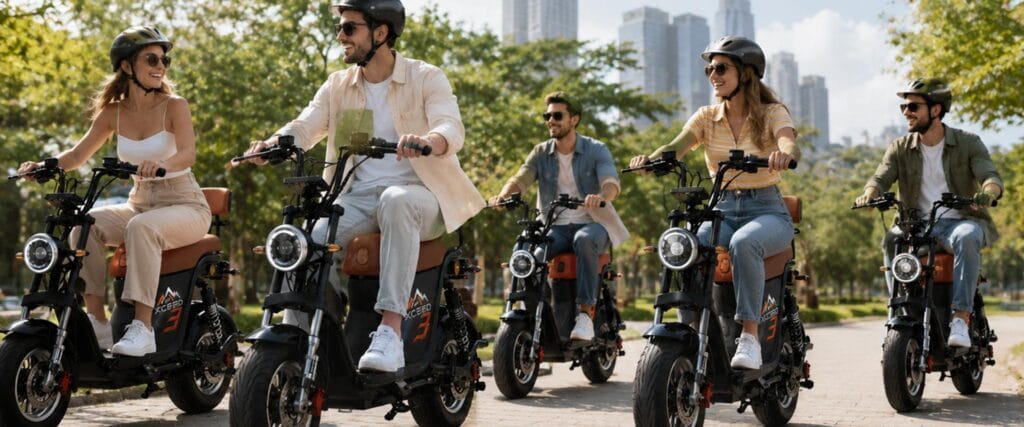
Sensor selection should not happen separately from motor selection.
Vélos électriques urbains de faible puissance
On a lower-power commuter platform, torque sensing can make assistance feel subtle and bicycle-like.
This may suit riders who still expect to pedal actively.
Modèles de style de vie à puissance supérieure
On a larger moped-style or fat-tire bike, the same technology can serve another purpose: managing stronger power more progressively.
Moteur de moyeu contre Mid-Drive
Torque sensing can appear in both hub-drive and mid-drive architectures depending on system design.
Mid-drive systems often integrate sensing around the crank or motor unit, while hub-motor systems may use separate bottom-bracket or axle-based sensing.
Neither architecture should be judged only by sensor type.
Contrôleur Courant
Controller current influences how much electrical power can be delivered.
A high-output controller combined with aggressive programming can make even a torque-sensing system feel very strong.
The motor, battery, controller, and sensor must therefore be evaluated together.
Sélection de batterie pour les vélos électriques à capteur de couple
Sensor technology does not change the fundamental role of the battery.
The battery must still supply energy for the motor and other electrical components.
Énergie de la batterie
A useful basic calculation is:
Battery energy in Wh = voltage × amp-hour capacity
For the S7’s 48V 18Ah configuration, nominal stored energy is approximately 864Wh. Its torque-sensing system operates as part of this wider 48V electrical platform.
Gestion de batterie
Lithium battery systems should use suitable protection and management for their chemistry and electrical requirements.
The U.S. Consumer Product Safety Commission continues to emphasize proper battery and charger use for micromobility products and warns against incompatible or modified lithium-ion battery systems. Its Micromobility Information Center provides current safety guidance for e-bikes and related products.
L'efficacité du capteur ne peut pas compenser une mauvaise batterie
A sophisticated sensor cannot correct:
- Poor-quality cells
- Undersized battery capacity
- Incorrect BMS settings
- Incompatible charger
- Weak connectors
- Poor wiring
- Excessive controller demand
The electrical system should always be evaluated as a complete package.
Capteur de couple Sécurité et contrôle du vélo électrique
Sensor response has a direct relationship with vehicle behavior.
Assistance prévisible
Motor assistance should increase in a controlled and repeatable way.
Unexpected surges can reduce rider confidence, particularly during starts or low-speed maneuvers.
Coupure de frein
Depending on the vehicle configuration, brake levers may include motor cut-off switches.
These switches interrupt motor assistance when braking.
Buyers should verify how the braking and drive-control systems interact.
Freinage Hydraulique
Higher-weight e-bikes often use hydraulic disc brakes because they can provide controlled braking with reduced cable-related adjustment.
The S7 uses hydraulic disc brakes on both the front and rear wheels as part of its current configuration.
Comportement de défaillance du capteur
Ask the supplier what happens if the torque sensor produces an abnormal signal.
The controller should have defined fault behavior rather than allowing uncontrolled assistance.
Inclure les contrôles de capteurs dans le contrôle qualité
Pre-shipment testing should verify:
- Sensor startup
- Assistance response
- Different PAS levels
- Brake cut-off
- Display communication
- Controller faults
- Wiring
- Connector security
Capteur de couple vs Capteur de cadence pour différents cavaliers
Choosing the best system becomes easier when the customer is clearly defined.
| Rider Type | More Suitable Direction | Why |
| Active commuter | Torque sensor | Natural assistance with rider input |
| Casual city rider | Either | Depends on desired riding feel |
| Rider wanting minimal effort | Cadence may suit | Motor can provide consistent support |
| Moped-style e-bike rider | Torque often valuable | Helps control heavier, stronger platform |
| Fitness-focused rider | Torque sensor | Maintains stronger connection to pedaling effort |
| Value-focused buyer | Cadence may suit | Simpler system |
| Premium lifestyle customer | Torque sensor | Supports refined product positioning |
| Mixed-terrain rider | Torque often useful | Assistance responds to changing effort |
Il n'y a pas de gagnant universel
A torque sensor is not automatically necessary for every low-cost city bicycle.
A cadence sensor is not automatically outdated.
The correct system depends on target customer expectations.
OEM Considerations for Torque Sensor E-Bikes
For private-label brands, sensor selection can become a meaningful point of differentiation.
Hongtu Future OEM and ODM customization can be used to coordinate electric bicycle configurations with target-market positioning.
Define the Riding Experience First
Before discussing components, determine whether the product should feel:
- Natural
- Powerful
- Relaxed
- Sport-oriented
- Utility-focused
- Premium
- Entry-level
Sensor selection should support that goal.
Tune Assistance Levels
A five-level assistance system should not simply provide five arbitrary power limits.
Each level should produce a logical progression.
For example, lower modes can emphasize rider effort, while higher modes provide stronger assistance.
Match Motor Output
A 250W urban bicycle, 750W fat-tire e-bike, and 1500W moped-style product should not necessarily use identical torque-response programming.
The stronger the motor, the more important controlled assistance can become.
Test Different Rider Weights
A lightweight rider and a heavier rider may apply different pedaling forces.
Sample testing should include a representative range of users.
Document the Approved Configuration
For mass production, record:
- Sensor model
- Sensor location
- Moteur
- Contrôleur
- Controller programming
- Affichage
- Assistance levels
- Batterie
- Wiring
- Firmware version where applicable
If one component changes later, assistance behavior may also change.
Common Torque Sensor E-Bike Buying Mistakes
Choosing by the Sensor Name Alone
“Torque sensor” describes a technology category, not guaranteed ride quality.
Calibration and controller programming still matter.
Ignoring Motor Programming
A high-quality sensor connected to poorly tuned motor control may still feel abrupt.
Sample testing is essential.
Assuming Torque Sensors Always Save Battery
Energy consumption depends on riding conditions and rider behavior.
Compare real routes instead of relying on theoretical claims.
Comparing Motor Wattage Only
Motor wattage does not explain acceleration behavior.
Controller current and pedal-assist programming can produce significant differences.
Ignoring Vehicle Weight
A heavy fat-tire or moped-style bike requires more energy to accelerate than a lightweight commuter bike.
Sensor behavior should be tested on the actual finished vehicle.
Forgetting After-Sales Parts
Importers should confirm sensor and controller replacement availability.
A small unavailable electronic component can make an otherwise functional e-bike unusable.
Torque Sensor E-Bike Procurement Checklist

Before approving an order, confirm:
- Target customer
- Intended application
- Destination market
- Required legal vehicle category
- Motor rated power
- Motor type
- Tension du contrôleur
- Contrôleur actuel
- Torque sensor type
- Sensor location
- Sensor supplier
- Pedal-assist levels
- Assistance response at startup
- Assistance response on hills
- Assistance response at low speed
- Brake cut-off behavior
- Vitesse maximale programmée
- Battery voltage
- Capacité de la batterie
- Chimie de la batterie
- BMS
- Charger specification
- Dimensions des pneus
- Poids du véhicule
- Braking system
- Suspension
- Conduite de vitesse
- Affichage
- Wiring and connectors
- Imperméabilisation
- Replacement sensor availability
- Replacement controller availability
- Manuel d'utilisation
- Diagnostic procedure
- Applicable certification
- Sample approval
- Pre-shipment testing
How This Article Supports Hongtu Future SEO
For a newly optimized website, a technical article should support more than one keyword.
This Torque Sensor E-Bike topic can strengthen semantic relevance around:
- torque sensor e-bike
- torque sensor electric bike
- torque sensor vs cadence sensor
- cadence sensor e-bike
- pedal assist sensor
- commuter e-bike
- moped style e-bike
- fat tire e-bike
- electric bicycle motor system
The most important internal link is the Commuter-Focused Moped Style E-Bike S7, because torque sensing is one of the product’s confirmed core specifications.
The article can also connect with the broader Lifestyle E-Bike category, which currently contains moped-style, single-suspension fat-tire, full-suspension fat-tire, and scooter-style models.
Related content should naturally include the existing Moped Style E-Bike Trends 2026 article rather than creating another page targeting the exact same broad keyword.
This creates a clearer topic structure:
The Moped Style E-Bike article covers the overall category and current trends.
This article focuses specifically on pedal-assist sensor technology.
The S7 product page handles transactional product intent.
The fat-tire product pages handle suspension and off-road configuration intent.
The OEM page handles customization and B2B manufacturing intent.
That separation helps reduce unnecessary keyword overlap while expanding the number of related searches the website can potentially address.
Conclusion
Torque sensors are becoming an increasingly useful differentiator as electric bicycles move beyond simple comparisons of motor power and battery capacity.
A Torque Sensor E-Bike measures rider effort and allows motor assistance to respond proportionally to pedaling force. This can create smoother starts, more progressive acceleration, more natural climbing support, and better control during changing riding conditions.
Cadence sensors still have an important place in the market.
Their simpler operation can be suitable for cost-conscious products and riders who want consistent electric assistance without needing the system to measure pedal pressure.
The correct choice therefore depends on the product.
For lightweight entry-level commuting, cadence sensing may be entirely appropriate.
For a premium commuter, moped-style model, fat-tire bike, or product where natural pedal response is a major selling point, torque sensing can provide a clearer technical advantage.
For B2B buyers, however, the most important lesson is that sensor type should never be evaluated alone.
Motor output, controller programming, battery capacity, tire size, gearing, brakes, vehicle weight, and rider expectations all contribute to the final result.
Hongtu Future Vélo électrique de style cyclomoteur S7 provides a current example of a torque-sensing system integrated with a 1500W motor, 48V 18Ah battery, hydraulic braking, and 20 × 4.5 wide tires.
For distributors building a broader portfolio, comparing sensor technologies alongside different Vélo électrique Lifestyle platforms can help create clearer entry-level, commuter, fat-tire, and premium product positions.
FAQ
What is a Torque Sensor E-Bike?
A Torque Sensor E-Bike measures how much force the rider applies to the pedals and adjusts motor assistance according to that effort. The harder the rider pedals, the more assistance the controller can provide within the selected riding mode and system limits.
Un capteur de couple est-il meilleur qu'un capteur de cadence ?
A torque sensor generally provides more proportional and bicycle-like assistance, while a cadence sensor provides motor support primarily according to crank movement and selected assistance settings. The better choice depends on rider expectations, product positioning, motor power, and budget.
Does a torque sensor make an e-bike easier to ride uphill?
It can improve how assistance responds during climbing because increased pedal force can trigger stronger motor support. Actual hill performance still depends on motor power, controller current, battery voltage, gearing, total weight, tire size, and road gradient.
Does a Torque Sensor E-Bike have longer range?
Not automatically. Torque sensing may help reduce unnecessary motor assistance in some situations, but range is also affected by battery energy, riding speed, rider weight, terrain, tire pressure, temperature, motor efficiency, and assistance level.
Is a torque sensor useful on a fat tire e-bike?
It can be particularly useful because fat-tire e-bikes are often heavier and require more energy during acceleration. Progressive assistance can make starts and changing terrain easier to control, although the final riding experience depends on the complete electric drive system.
What is the difference between cadence and torque?
Cadence measures how quickly the pedals rotate. Torque measures the rotational force produced by the rider. A cadence sensor therefore detects pedal movement, while a torque sensor detects rider effort.
Is a torque sensor good for a moped-style e-bike?
Yes, it can be a useful choice for heavier moped-style products because it allows motor support to respond to actual pedal pressure. This can help create more progressive assistance when starting, climbing, or riding at low speed.
Can torque sensor sensitivity be customized?
Depending on the controller and drive system, manufacturers may be able to adjust assistance mapping, response strength, and pedal-assist levels. OEM buyers should define these settings during sample development and verify them before mass production.
What should I test before buying a Torque Sensor E-Bike in bulk?
Test low-speed starts, different assistance levels, hills, normal cruising, braking, rider weight changes, battery consumption, sensor consistency, controller response, and fault behavior. The exact approved sample should then be documented for production.
Is a torque sensor more expensive than a cadence sensor?
Torque-sensing systems are generally more complex and can add cost compared with simpler cadence-sensor systems. However, the actual price difference depends on sensor design, controller integration, supplier, motor system, and production volume.