Tabla de contenidos
Conclusiones clave:
- Moped-style electric bikes are becoming a more visible segment between conventional commuter e-bikes and motorcycle-inspired electric mobility.
- Wide tires, long seats, stronger motors, hydraulic brakes, suspension, and motorcycle-style frames are major characteristics of this category.
- Commuting remains an important use case, but a heavier moped-style design creates different requirements for storage, handling, braking, battery capacity, and legal classification.
- Torque sensors are increasingly valuable because they allow electric assistance to respond to actual rider pedaling force rather than only crank movement.
- Fat tires can improve comfort and surface adaptability, but they also increase weight and rolling resistance.
- Higher motor power can support acceleration and gradients, but it can also move a product outside conventional e-bike classifications in some markets.
- Importers should define the destination market and legal vehicle category before choosing motor power and maximum speed.
- Battery and electrical-system safety should be treated as a complete system involving the cells, BMS, controller, wiring, charger, and connectors.
- For new electric mobility brands, moped-style models can provide stronger product differentiation than another visually generic commuter bicycle.
Introducción
Electric bicycles have diversified rapidly.
A few years ago, many e-bikes followed a relatively conventional bicycle format: narrow tires, adjustable saddles, step-through or diamond frames, modest electric assistance, and a design focused primarily on practical transportation.
In 2026, the market contains a much wider range of categories.
Traditional commuter bicycles remain important, but fat-tire bikes, cargo e-bikes, folding models, retro electric bikes, and motorcycle-inspired machines have created more clearly defined product segments.
El Bicicleta eléctrica estilo ciclomotor sits at an especially interesting point within this development.
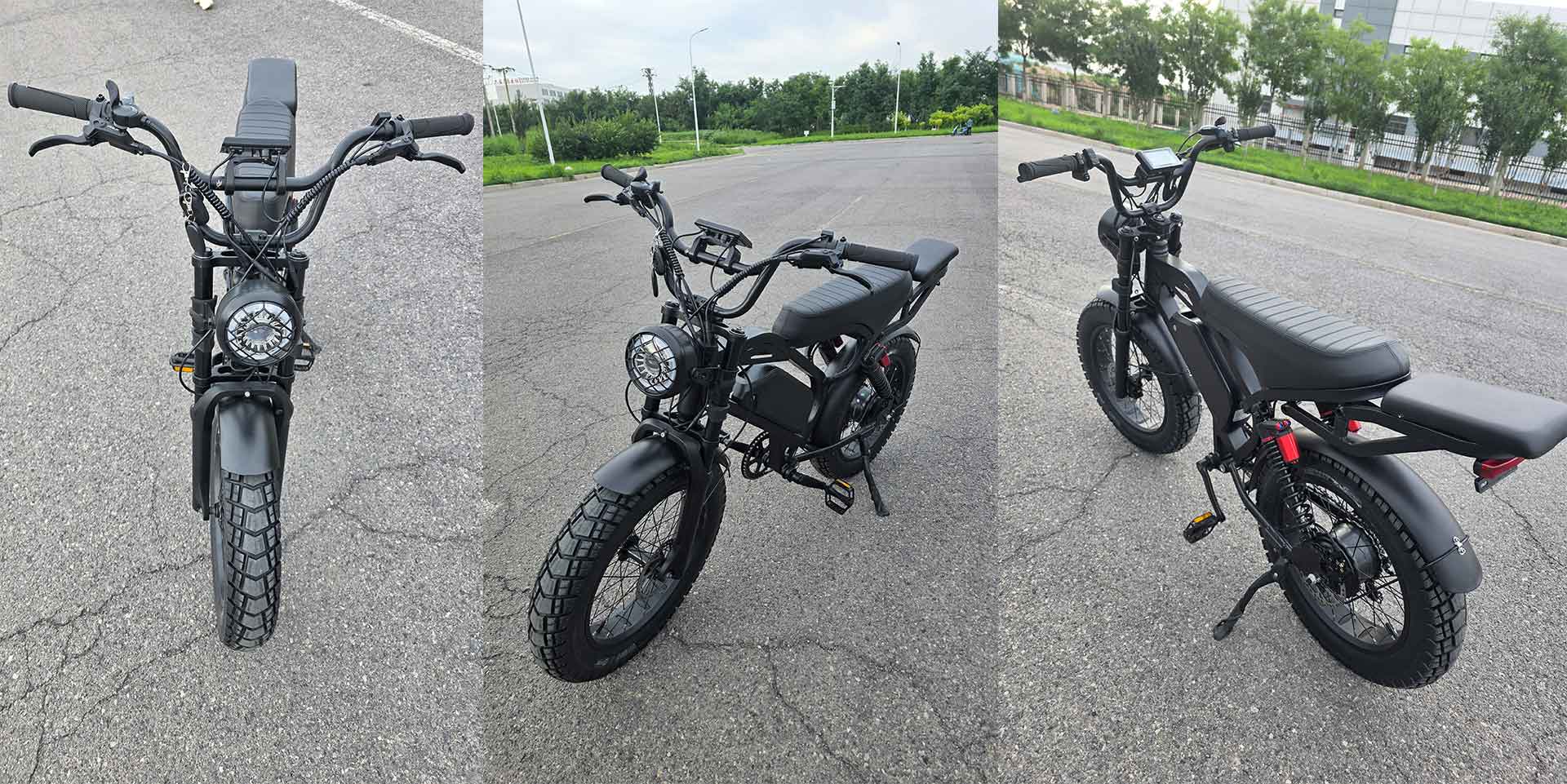
It combines functional electric bicycle components with design elements commonly associated with mopeds and lightweight motorcycles. These may include a long bench seat, large headlight, wide tires, substantial frame, higher-output motor, hydraulic braking, and a more relaxed riding position.
Recent 2026 electric-bike guides increasingly treat moped-style and fat-tire e-bikes as recognizable categories alongside conventional commuter bikes, while current electric motorcycle development also shows growing consumer interest in machines that combine classic or motorcycle-inspired styling with electric propulsion.
At the same time, the global electric two- and three-wheel market continues to expand. According to the International Energy Agency’s Global EV Outlook 2026, electric two- and three-wheeler sales increased by almost 15% in 2025 to around 11 million units globally.
For distributors, importers, retailers, and private-label brands, this makes the category worth understanding more carefully.
The important question is not simply whether a Moped Style E-Bike looks more attractive than a normal bicycle.
The more useful questions are:
What type of customer is it designed for?
How should the motor, battery, brakes, tires, suspension, and sensor system work together?
Can it legally be sold and operated as an e-bike in the target market?
And when does a moped-inspired design make more sense than a conventional commuter or fat-tire off-road bicycle?
What Is a Moped Style E-Bike?
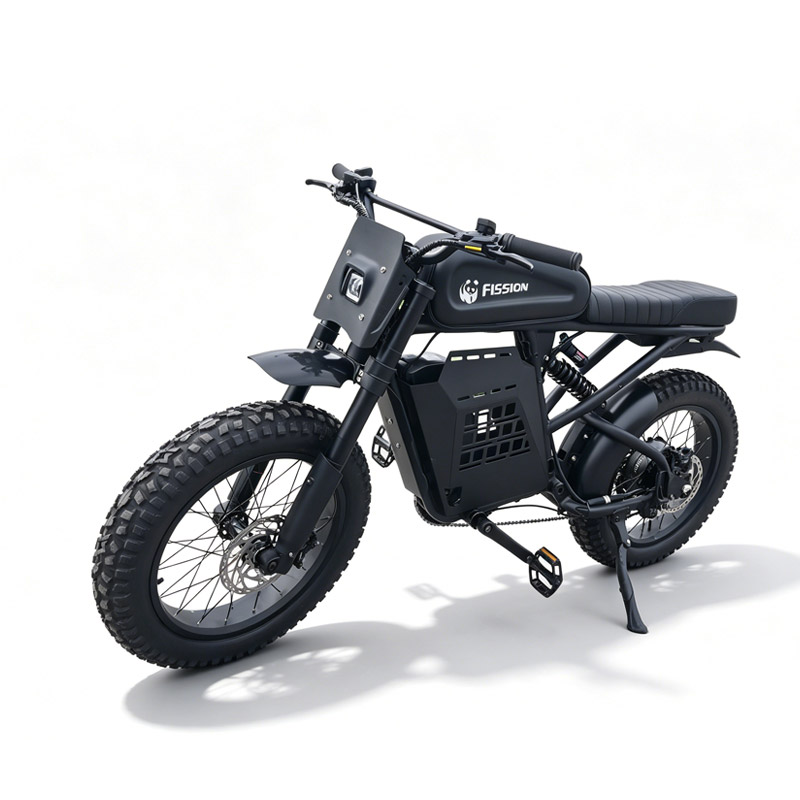
A Moped Style E-Bike is an electric bicycle whose frame, seat, tires, handlebars, and overall proportions borrow visual or functional characteristics from traditional mopeds or small motorcycles.
It normally retains pedals and an electric-assistance system, but the riding experience can feel substantially different from that of a conventional city bicycle.
The general electric bicycle category includes many different designs, power systems, sensors, battery configurations, and regulatory classifications. A moped-style model represents one design direction within that much broader market.
Long Bench-Style Seat
Instead of a narrow bicycle saddle mounted on a long seat post, many moped-inspired designs use an extended padded seat.
This creates a lower and more relaxed riding position while strengthening the motorcycle-inspired appearance.
Depending on vehicle design and local laws, some models may also provide space for a passenger.
Wide Tires
Fat or semi-fat tires are frequently used to give the bike a substantial stance and provide greater tire volume between the rim and road surface.
Current Hongtu Future’s Bicicleta eléctrica estilo ciclomotor centrada en viajeros -stanche S7 uses 20 × 4.5 off-road tires, creating a noticeably wider profile than a conventional city bicycle.
Motorcycle-Inspired Frame
The frame can be lower, longer, and visually heavier than a traditional bicycle frame.
Battery placement, headlight design, suspension components, handlebars, and seat position are usually integrated around this overall appearance.
Electric Assistance
A Moped Style E-Bike may use pedal assistance, throttle control, or a combination depending on configuration and destination-market regulations.
The assistance system can use cadence sensing or torque sensing to determine how motor power responds to the rider.
Why the Category Is Different
The difference is not only cosmetic.
Changing tire width, frame geometry, motor output, seat structure, and overall vehicle weight also changes:
- Handling
- Braking demand
- Energy consumption
- Storage requirements
- Pedaling efficiency
- Suspension requirements
- Transport volume
- Rider expectations
- Regulatory classification
That means a moped-style product should be evaluated as a complete vehicle instead of simply as a conventional bicycle with different bodywork.
Why Moped Style E-Bikes Are Relevant in 2026
Several trends are converging around this product category.
Electric two-wheel mobility is expanding internationally, commuters increasingly expect greater comfort and utility, and electric vehicle styling is becoming more diverse.
Electric Two-Wheelers Continue to Expand
Electric two- and three-wheelers remained the most electrified road transport category in 2025, with approximately 10% of the global fleet already electric.
The IEA also reported particularly strong momentum entering 2026. In the first quarter of 2026, electric two- and three-wheeler sales more than doubled year over year in Southeast Asia and grew by more than 30% in India. (IEA Global EV Outlook 2026)
This does not mean every electric two-wheeler category grows equally in every region, but it supports a wider shift toward electrified short-distance transportation.
Commuters Want More Than Basic Transportation
Traditional commuter e-bikes prioritize practicality and efficiency.
However, some riders also want:
- More substantial tires
- A comfortable seat
- Stronger acceleration
- A motorcycle-inspired appearance
- Better shock absorption
- Larger integrated lights
- A stronger visual identity
This creates a space between a normal bicycle and an electric motorcycle.
Motorcycle-Inspired Electric Design Is Becoming More Visible
The distinction between e-bikes, e-mopeds, and lightweight electric motorcycles is increasingly important.
Recent 2026 electric-motorcycle releases show manufacturers experimenting with retro, café-racer, urban, and compact motorcycle styling while adapting power and speed configurations to different regulatory categories.
This trend creates opportunities, but it also makes accurate product classification increasingly important.
Moped Style E-Bike vs Standard Commuter E-Bike
A standard commuter bicycle and a moped-style model can both serve daily transportation, but they approach the task differently.
| Característica | Bicicleta eléctrica estilo ciclomotor | Standard Commuter E-Bike |
|---|---|---|
| Design | Motorcycle or moped inspired | Traditional bicycle inspired |
| Seat | Often long and fixed-height | Usually adjustable bicycle saddle |
| Tires | Frequently wide or fat | Usually narrower |
| Vehicle weight | Generalmente más alto | Usually lower |
| Pedaling efficiency | Often secondary to electric support | Usually more important |
| Rider posture | Relaxed, upright | Upright or slightly forward |
| Motor positioning | Often higher-output hub system | Wide range of hub/mid-drive options |
| Almacenamiento | Requires more space | Easier to store |
| Visual differentiation | Strong | Moderate |
| Mejor ajuste | Lifestyle + commuting | Utility-focused commuting |
When a Standard Commuter Is Better
A conventional commuter model may make more sense when the rider:
- Carries the bike upstairs
- Needs compact storage
- Pedals frequently without assistance
- Uses narrow bicycle infrastructure
- Prioritizes lightweight handling
- Needs a highly adjustable riding position
The lighter structure can be especially useful for riders combining cycling with trains, elevators, apartments, or office storage.
When a Moped Style E-Bike Is Better
A Moped Style E-Bike can be attractive when riders prioritize:
- Comfortable electric-assisted transportation
- Wide tires
- Motorcycle-inspired styling
- Strong acceleration
- Larger lighting systems
- Relaxed seating
- Urban lifestyle positioning
- Distinctive product appearance
For retailers, this also creates another benefit: stronger visual differentiation.
Why Fat Tires Remain Important
Fat tires are one of the most visible characteristics of many moped-style electric bicycles.
Recent 2026 testing continues to highlight fat-tire e-bikes for their comfort and ability to handle gravel, poor pavement, mud, and other changing surfaces, although reviewers also consistently note the additional bulk and weight associated with the format.
More Tire Volume
A wider tire contains a larger air volume than many narrow commuter tires.
This can help absorb some small road irregularities before movement reaches the frame and rider.
However, tires should not be confused with suspension.
Tires deform at the road surface, while suspension controls movement between the wheels and frame.
Wider Contact Profile
Fat tires create a broad visual and physical contact profile.
Actual traction depends on several factors:
- Tire compound
- Tread
- Pressure
- Superficie de la carretera
- Vehicle weight
- Rider input
- Weather
Simply making a tire wider does not automatically guarantee better grip.
The Efficiency Trade-Off
Wide tires normally increase:
- Peso
- Rolling resistance
- Rotating mass
- Storage width
- Shipping volume
Therefore, a fat-tire design should be selected because it suits the product position and intended road conditions—not simply because bigger tires appear more powerful.
Moped Style E-Bike vs Fat Tire Off-Road E-Bike
These categories can overlap.
A moped-style model may use fat tires, while a fat-tire off-road bicycle may still maintain a more conventional bicycle riding position.
| Comparison | Bicicleta eléctrica estilo ciclomotor | Fat Tire Off-Road E-Bike |
| Primary identity | Moped/motorcycle styling | Surface adaptability |
| Seat | Long bench seat common | Adjustable bicycle saddle more common |
| Marco | Low, elongated | Bicycle-oriented geometry |
| Tires | Wide tires common | Fat tires central to design |
| Pedaling | Often less natural | More conventional bicycle pedaling |
| Suspensión | Depends on model | Front or full suspension common |
| Main use | Commuting + lifestyle | Mixed terrain + recreational riding |
| Visual style | Motorcycle influenced | Adventure/off-road influenced |
Hongtu Future currently offers both approaches.
El S7 Moped Style E-Bike uses 20 × 4.5 tires and a moped-inspired configuration, while the Bicicleta eléctrica todoterreno con neumáticos gruesos y suspensión única uses a 750W hub motor, 48V 18Ah battery, 20 × 4.0 tires, front suspension, and a rigid rear frame.
Buyers who want more complete shock isolation can also compare the Bicicleta eléctrica todoterreno con neumáticos gruesos y suspensión total, which adds rear suspension to the same general 750W, 48V 18Ah fat-tire platform.
Why Torque Sensors Matter More in 2026
Sensor technology has become an increasingly useful way to differentiate electric bicycle riding behavior.
Two common systems are cadence sensing and torque sensing.
Cadence Sensor
A cadence sensor primarily detects whether the crank is rotating.
Once pedaling begins, the controller provides assistance according to the selected support level and programmed settings.
This system can be simple and practical, but power delivery may feel less connected to how strongly the rider is pedaling.
Torque Sensor
A torque sensor measures the force applied through the pedals or drivetrain.
When the rider pushes harder, the system can increase assistance. When pedal force decreases, the system can reduce it.
This creates a more proportional relationship between human input and motor assistance.
The S7 currently uses a torque-sensing drive system, allowing motor assistance to respond to rider pedaling force.
Torque Sensor vs Cadence Sensor
| Característica | Torque Sensor | Cadence Sensor |
| Detects | Pedaling force | Pedal/crank movement |
| Motor response | Proportional to effort | Based primarily on rotation |
| Ride feeling | More natural | More noticeable motor engagement |
| Stop-start control | Can feel progressive | Depends heavily on programming |
| Complexity | Más alto | Simpler |
| Product positioning | Performance / refined assistance | Practical / cost-conscious |
Why It Matters on a Heavy Bike
A heavier moped-style vehicle can require more controlled assistance during starts, corners, and slow-speed riding.
A well-tuned torque system can help the motor output follow rider intention more progressively.
However, sensor type alone does not determine ride quality.
Controller software, motor characteristics, gearing, tire size, and vehicle weight remain equally important.
How Much Motor Power Does a Moped Style E-Bike Need?
This is becoming one of the most important questions in the category.
The answer should begin with legal classification, not simply performance.
Motor Power Affects More Than Speed
A stronger motor can support:
- Faster acceleration
- Better loaded starts
- Hill climbing
- Higher sustained speeds
- Heavier vehicle structures
However, it may also result in:
- Higher battery demand
- More controller current
- Greater braking requirements
- Higher component loads
- Different legal classification
750W vs 1500W
A 750W system can provide strong assistance for many fat-tire applications while remaining closer to common North American low-speed e-bike power thresholds.
A 1500W platform, such as the one used on Hongtu Future’s S7, provides a different performance position and should therefore be evaluated carefully according to local rules.
Important U.S. Classification Point
The U.S. Consumer Product Safety Commission defines a low-speed electric bicycle for its bicycle requirements as a vehicle with fully operable pedals, an electric motor of less than 750 watts, and a motor-only maximum speed below 20 mph under specified test conditions. (CPSC Bicycle Requirements)
State traffic laws may establish additional e-bike classes and operating requirements.
Therefore, a higher-power configuration should not automatically be advertised as a normal legal e-bike in every U.S. market.
European Market Considerations
European rules also distinguish conventional pedal-assisted bicycles from higher-power or higher-speed vehicles.
Electric bicycles that exceed ordinary pedal-assist thresholds may fall into different vehicle categories requiring additional approval or operating requirements.
Manufacturer Implication
This is why one global motor specification is not always the best strategy.
OEM manufacturers may need to provide different configurations for:
- United States
- European Union
- United Kingdom
- Latin America
- Southeast Asia
- Middle East
- Africa
- Private-site or off-road use
Motor power, controller programming, throttle configuration, and maximum speed should be determined before certification and production.
Battery Capacity Should Match the Use Case
A larger battery is not automatically the best battery.
Battery selection should reflect how the vehicle will actually be used.
Calculate Nominal Battery Energy
The S7 uses a 48V 18Ah battery.
Its nominal energy is approximately:
48 × 18 = 864 Wh
This figure provides a more useful technical comparison than amp-hours alone.
Real Range Depends on Many Variables
Actual riding distance depends on:
- Rider weight
- Motor output
- Tire width
- Tire pressure
- Average speed
- Terrain
- Gradient
- Assistance level
- Temperatura
- Stop frequency
- Wind
- Edad de la batería
A heavy 1500W moped-style model should not be expected to achieve the same efficiency as a lightweight city bicycle simply because both use batteries with similar nominal energy.
Removable vs Fixed Battery
A removable battery can simplify charging when the vehicle is stored away from an electrical outlet.
It may also help fleet operators rotate batteries between vehicles.
However, removable battery design must maintain:
- Secure locking
- Strong electrical connectors
- Water protection
- Vibration resistance
- Reliable mounting
Battery Safety Is Becoming a Bigger Buyer Concern
Battery safety remains a major issue in electric micromobility.
The U.S. Consumer Product Safety Commission continues to publish safety guidance and warnings involving lithium-ion batteries, wiring, chargers, and complete micromobility electrical systems. The agency specifically advises users to use compatible replacement batteries and avoid modified or rebuilt battery packs from unqualified sources. (CPSC Micromobility Safety Center)
For B2B procurement, this means battery sourcing should not be reduced to voltage and capacity.
Battery Cell Quality
Buyers should request information about:
- Cell chemistry
- Cell supplier
- Battery configuration
- Nominal voltage
- Nominal capacity
- Maximum current
- Charging current
- Cycle-test conditions
Sistema de gestión de baterías
A suitable BMS can provide functions related to:
- Overcharge
- Over-discharge
- Excess current
- Short circuit
- Temperatura
- Cell balancing
The exact functions should be documented.
Charger Compatibility
Battery and charger must be treated as a matched system.
An incorrectly specified charger may create excessive charging voltage, inappropriate current, connector problems, or other electrical risks.
Avoid Unverified Battery Substitution
One common procurement mistake is changing battery suppliers after sample approval without repeating system testing.
Even when nominal voltage and capacity appear identical, differences in cells, BMS settings, connectors, current capability, dimensions, and communication systems may affect performance and safety.
Why Hydraulic Brakes Matter on Moped-Style Models
Vehicle mass and speed influence braking demand.
A heavier moped-style bicycle equipped with broad tires, a larger motor, extended seat, and substantial frame may require a stronger braking system than a lightweight city bicycle.
The Hongtu Future S7 is equipped with front and rear hydraulic disc brakes.
Hydraulic vs Mechanical Disc Brakes
Mechanical disc brakes usually operate through cables.
Hydraulic systems use brake fluid to transfer lever pressure to the caliper.
Potential advantages of hydraulic systems include:
- More progressive lever response
- Reduced cable stretch
- Strong controllable braking
- Better integration with heavier products
Actual braking performance still depends on:
- Rotor size
- Caliper
- Brake pads
- Tire grip
- Vehicle weight
- Road conditions
- Mantenimiento
Test Under Real Load
A braking test should include the intended rider weight.
For models designed to carry a passenger, testing should also account for the approved combined load.
An unloaded factory test cannot accurately represent stopping behavior at normal operating mass.
Commuting vs Lifestyle: Who Is the Real Customer?
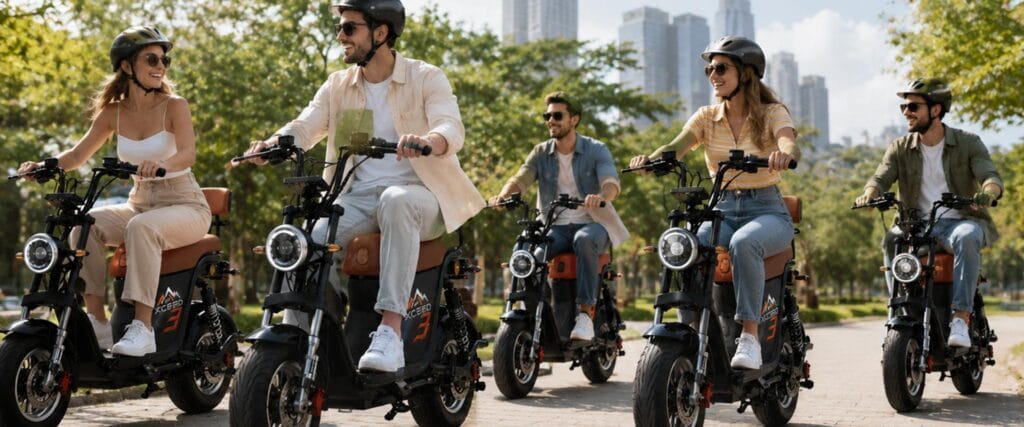
The word “commuter” covers a wide range of riders.
Not every commuter wants a lightweight bicycle.
The Practical Commuter
This rider prioritizes:
- Low vehicle weight
- Efficient pedaling
- Rack compatibility
- Fenders
- Compact storage
- Long range
- Easy maintenance
A conventional city e-bike may be better.
The Lifestyle Commuter
This rider may prioritize:
- Appearance
- Strong acceleration
- Wide tires
- Comfortable seating
- Large headlight
- Relaxed riding posture
- Distinctive design
A Moped Style E-Bike may better fit these expectations.
The Mixed-Use Rider
Some riders use one vehicle for:
- Commuting
- Local errands
- Weekend cruising
- Light gravel routes
- Social riding
For this user, a moped-style fat-tire configuration can provide a useful compromise between city utility and recreational riding.
What Should Importers Check Before Ordering?
A product image cannot answer most procurement questions.
Before approving a Moped Style E-Bike, buyers should document the complete configuration.
Electric Drive
Confirm:
- Rated motor output
- Peak output if applicable
- Controller current
- Controller voltage
- Assistance modes
- Throttle behavior
- Sensor type
- Maximum programmed speed
Batería
Confirm:
- Chemistry
- Voltage
- Capacity
- Cell supplier
- BMS functions
- Charge current
- Battery mounting
- Connector
- Warranty
Mechanical System
Confirm:
- Frame material
- Frame geometry
- Tire dimensions
- Suspensión
- Brake type
- Brake rotor
- Drivetrain
- Pedal system
- Maximum load
Electrical Equipment
Confirm:
- Faro
- Luz trasera
- Turn signals if included
- Horn
- Display
- Wiring connectors
- Waterproofing
- Charger plug
Documentation
Request:
- User manual
- Battery documentation
- Charger specifications
- Wiring diagram
- Spare-parts list
- Packing details
- Applicable test reports
- Certification documentation
OEM Opportunities for Moped Style E-Bikes
Moped-style vehicles are highly suitable for private-label differentiation because appearance plays a major role in the purchase decision.
Hongtu Future OEM & ODM electric bike customization supports customization across branding, frame design, battery options, motor configurations, packaging, colors, and other market-specific requirements.
Color and Graphics
A recognizable color scheme can separate a private-label model from generic marketplace products.
Possible areas include:
- Marco
- Fork
- Wheels
- Seat stitching
- Decals
- Battery casing
- Packaging
Iluminación
A distinctive headlight can reinforce the motorcycle-inspired identity.
However, lighting changes should also be checked against destination-market requirements.
Motor and Speed Configuration
A manufacturer may need multiple electrical configurations for different markets.
The most powerful version should not automatically become the default export configuration.
Suspension Options
For brands targeting urban customers, front suspension may provide sufficient comfort with a simpler frame.
For rougher routes or higher product positioning, full suspension can provide another differentiation point.
Buyers can compare this approach with Hongtu Future’s Full-Suspension Fat Tire E-Bike when planning multiple lifestyle product levels.
Moped Style E-Bike Procurement Checklist
Before approving production, confirm that you can answer these questions:
- What country will the product be sold in?
- What legal vehicle category should it meet?
- What motor power is permitted?
- What maximum speed is permitted?
- Is throttle operation allowed?
- Are fully operable pedals required?
- What battery capacity is needed?
- Which cells and BMS are used?
- What sensor system is installed?
- What controller current is used?
- What tire dimensions are specified?
- Are replacement tires locally available?
- What braking system is included?
- What is the rated rider load?
- Is passenger use permitted?
- What suspension configuration is required?
- Is the battery removable?
- What charger is supplied?
- What plug type is required?
- What lighting equipment is required?
- What certification is required?
- What spare parts should ship with the order?
- Has the exact production sample been approved?
- Can branding and packaging be customized?
- Has a pre-shipment inspection plan been defined?
How This Topic Fits the Hongtu Future Product Range
For a new website, SEO content should not exist as isolated blog posts.
Each article should help Google and users understand relationships between categories, applications, and products.
This article can connect directly with the website’s Lifestyle E-Bike collection and the S7 Moped Style E-Bike.
It can also distribute internal relevance toward:
- Bicicleta eléctrica todoterreno con neumáticos gruesos y suspensión única
- Bicicleta eléctrica todoterreno con neumáticos gruesos y suspensión total
- Patinete eléctrico Harley retro
- OEM & ODM Customization
- Best Retro Electric Bike Models for 2026
This creates a broader semantic cluster around moped style e-bike, fat tire e-bike, retro electric bike, commuter electric bike, electric scooter, torque sensor e-bike, and lifestyle electric mobility.
For a young domain, building these connected topical clusters is generally more useful than publishing many unrelated high-volume keywords.
Conclusión
The Moped Style E-Bike is becoming an increasingly recognizable part of the electric two-wheel market because it provides something that a conventional commuter bicycle does not always deliver: a combination of electric transportation, comfort, wide-tire stability, stronger visual identity, and motorcycle-inspired design.
However, the category also requires more careful product planning.
A heavier frame, larger motor, wider tires, extended seat, and greater electrical output can affect range, braking, handling, battery demand, shipping, and regulatory classification.
For buyers in 2026, the correct selection process should therefore begin with the intended market rather than the maximum specification.
Define the rider.
Define the route.
Define the legal vehicle category.
Then determine the motor, controller, battery, sensor system, braking, tires, suspension, and speed configuration that fit those requirements.
Models such as Hongtu Future’s S7 Moped Style E-Bike illustrate how current products are combining torque sensing, hydraulic braking, wide tires, higher-output electric systems, and commuter-oriented motorcycle styling in one platform.
As electric two- and three-wheel mobility continues expanding globally, the brands that succeed are likely to be those that match distinctive product design with clear market positioning, compliant specifications, reliable electrical systems, and consistent manufacturing.
Preguntas frecuentes
What is a Moped Style E-Bike?
A Moped Style E-Bike is an electric bicycle designed with visual and functional elements inspired by mopeds or lightweight motorcycles. It commonly uses a long seat, wide tires, substantial frame, electric assistance, integrated lighting, and a relaxed riding position while retaining pedals.
Is a Moped Style E-Bike good for commuting?
It can be suitable for commuting when the rider values comfort, electric assistance, wide tires, and a motorcycle-inspired riding position. However, these models are usually heavier than standard commuter bikes, so buyers should also consider storage, route distance, battery capacity, road conditions, and local regulations.
Is a torque sensor better than a cadence sensor?
Neither system is universally better. A torque sensor responds to how strongly the rider pedals and can create more proportional assistance. A cadence sensor mainly detects crank rotation and usually uses a simpler control approach. The right system depends on riding expectations, product positioning, and cost targets.
Are fat tires necessary on a Moped Style E-Bike?
No. Fat tires are common because they support the substantial appearance and can provide greater tire volume on rough or uneven surfaces. However, they also increase weight, rolling resistance, and vehicle width. Tire size should match the intended road environment rather than simply following appearance trends.
Can a 1500W Moped Style E-Bike be sold as a normal e-bike?
Not automatically. Vehicle classification depends on the destination market. For example, U.S. federal CPSC bicycle requirements define a low-speed electric bicycle using a motor below 750W together with other conditions. Higher-power models may fall under different state or vehicle rules, so importers should verify compliance before ordering.